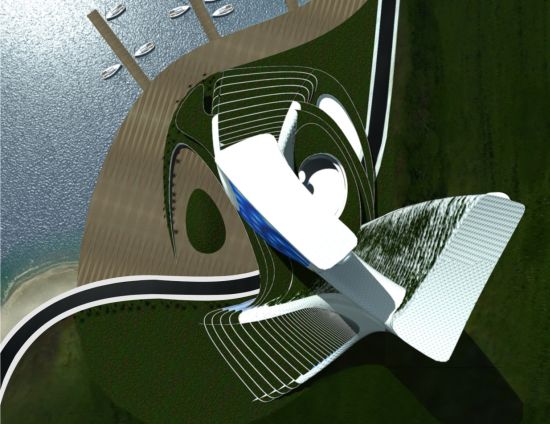
15 Amazing Skyscrapers Based on Sustainable Design

In our days everybody’s thinking about global warming, and the effects that this is causing on the climate change and of course on the entire world. The scientific consensus is that global warming is occurring and is mostly the result of human activity, and this fact is recognized by the national science academies of all the major industrialized countries and is not rejected by any scientific body of national or international standing.
With all of this problems occurring in this century of speed, the architects are designing new techniques to reduce the energy needs of buildings and increase their ability to capture or generate their own energy, but also new concepts based on sustainable architecture. This new trend of eco architecture provides not only imaginative, but also expressive solutions and is characterized by the generation of highly creative designs, with cultural as well as architectural impacts. The new concept of sustainable architecture seeks to minimize the negative environmental impact of buildings by enhancing efficiency and moderation in the use of materials, energy, and development space. The revolutionary idea of sustainability and ecological design, is to ensure that our everyday actions and decisions will not damage the opportunities of future generations.
We support the Eco-Architecture, and we think that this new concept represents the future, that’s why for today we’ve prepared 15 eco-architecture proposals that can generate all the energy they need using renewable sources of energy and reduce the burden on the electrical grid.
1. 10MW Tower in Dubai
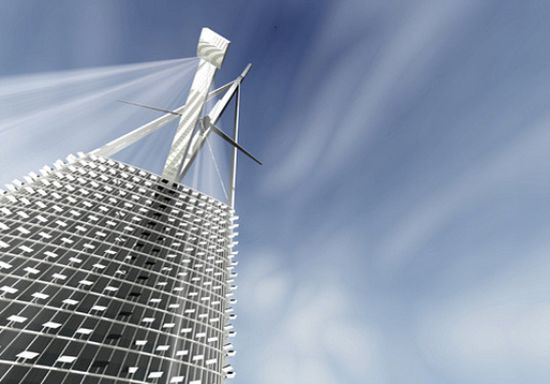
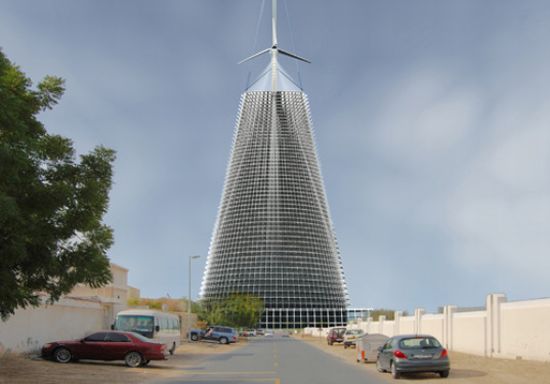
This impressive skyscraper has been designed by Studied Impact and is a sustainable tower designed to generate 10X more renewable energy that it consumes. Hard to believe? Well, this tower is equipped with a 5MW wind turbine that is located on top of the building harnessing the wind, a 3MW concentrating solar system and also an additional 2MW to be generated with a solar updraft system.
This 10MW skyscraper will be located in the Al Quoz neighborhood in Dubai, and is designed to have clear access to sunlight from all sides. The structure will include shopping, commercial areas and restaurants at the first three floors, and at the top a beautiful living roof garden will be watered using condensate from the building’s air handling units. The building tries to set a record due to its design that will be able to neutralize its embodied energy of 360,000 MWh in less than 20 years, something that was never accomplished. The south facing façade will include an innovative solar concentrating system that will feature 1600 heliostatic mirrors that direct sunlight to a receiver mounted above the mirrors on a cantilevered arm.
2.Costanera Sur
This amazing project has been designed by VisionDivision, and it brings something new to the table, something different from the usual skyscrapers loaded with offices or apartments. This new and unique skyscraper will provide sustainable living space for animals.
Its building tries to resemble with a vertical zoo, but the concept exterior design is to create an unique waterfall skyscraper. Also known as the Costanera Sur, this vertical zoo will be built from debris left over from the construction of Buenos Aires’ decades-old highways and will be self-sufficient in terms of water and energy. So, what’s with the waterfall? There’s a strong relation between the waterfall and the skyscraper, so that the building will have a central pipe structure that will draw water from a nearby river and pump it to the top. This way, the water will then be allowed to flow down the skyscarper’s façade creating an amazing waterfall. The basement of the building will feature turbines and a central generator that will produce electricity from this waterfall.
This is one of those concepts that seems really far from the reality, but the idea is quite interesting and original. Although, i think it would be much interesting to house offices and stores, so that you could feel like you’re in the center of a real waterfall.


3.Water-Scraper
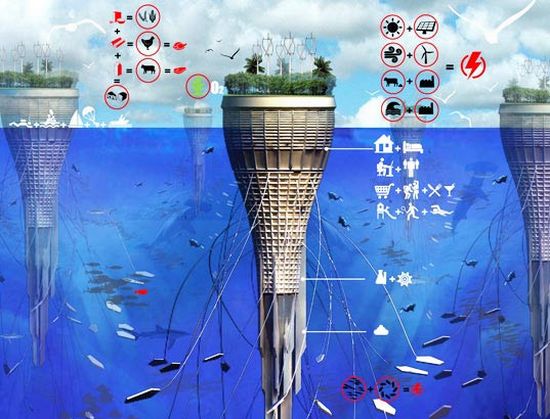
This amazing and futuristic Water-Scraper project has been designed by Sarly Adre Bin Sarkum and represents a response of what futuristic skyscrapers could look like due to the major problem of this century, which is the global warming. So , this is something that could replace the future buildings, since the thread of ocean levels that are rising around the globe it’s starting to be a real concern. So rather than tethering our buildings to the sinking shoreline why not suit them for a life at sea?
The concept idea of this futuristic project is a self-sufficient floating city, based on a variety of green technologies. This way, the electricity is generated using waves, wind, and solar power and it is able to produce its own food through farming, aquaculture, and hydroponic techniques. The design expands the concept of a floating island into a full-fledged underwater skyscraper that harvests renewable energy and grows its own food.
The structure is kept upright using a system of ballasts aided by a set of squid-like tentacles that generate kinetic energy. On top of this water skyscraper there’s a small forest, while the lower levels contain spaces for its inhabitants to live and work. The architects said a few words about their concept: “envision a future where land as a resource will be scarce; it is only natural progression that we create our own. Approximately 71% of the Earth’s surface is ocean, even more if climate change has its way, hence it is only natural progression that we will populate the seas someday.”
4.Oasis Tower for Zabeel Park
The Oasis Tower for Zabeel Park has been designed by Rahul Surin, and is located in Dubai. It represents an answer to the rise in population and the dearth in the amount of land available for farming.
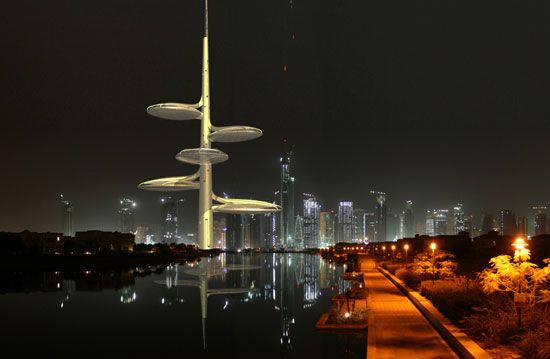
The tower will provide a solution for urban farming and also sustainable housing, and will harvest both solar and wind energy. The architect thinks that this innovative Oasis Tower will be able to provide food enough to feed 40,000 people per year. The Oasis Tower uses different farming techniques that will employ the latest in renewable energy technologies incorporating micro vertical-axis wind turbines and a photovoltaic E.T.F.E façade, both of them will satisfy most of the building’s energy demands. Its facade will provide the maximum energy generation due to its renewable energy systems.
The design will take the shape of an hexagram, which can also be seen as the combination of the negative and positive nullifying each other and thus claiming equilibrium.

5.Gesterbine Skyscraper
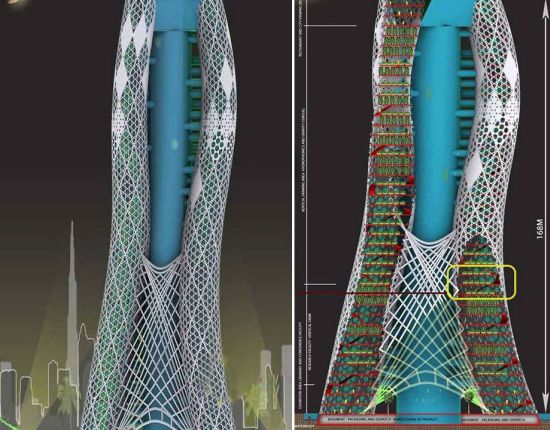
This amazing Gesterbine skyscraper has been designed by Polish architecture firm Mode Lina Architektura & Consulting and is envisioned for Greater Poland, an area characterized by a small amount of precipitation.
The eco factor of the Gesterbine sustainable skyscraper is about harvesting wind energy, and the concept design was to maximize energy generation using a series of wind turbines, human kinetics and water. Well, how it works you may wonder?
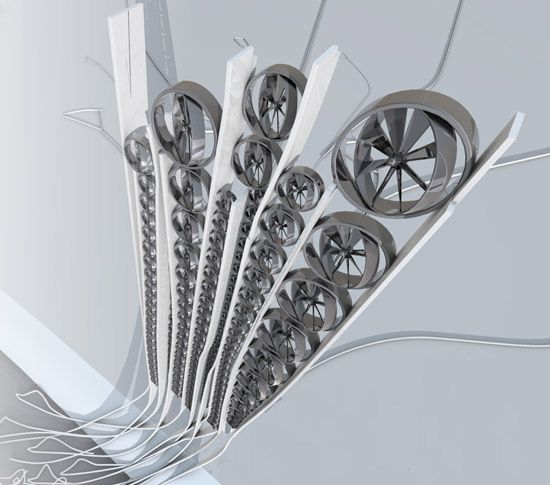
The Gesterbine uses wind energy, most of this energy is received during the day, when the energy demand is very high to provide as much renewable electricity it can to households, farms and small offices. During the night, when the energy demand falls, the turbines generate electricity to power water pumps that transport river water into the land. The water is used not only to support but also to create small retention water reservoirs, that will also retain water for as long as possible within the land raising levels of ground water. The Gesterbine Skyscraper comes equiped with a large number of small turbines which help generate energy needed to support the neighboring units.

6.Aviapolis Tower
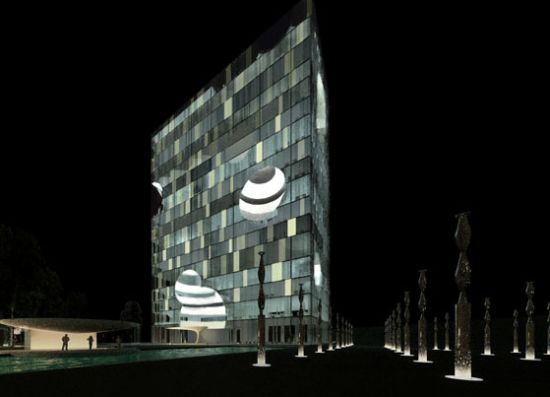
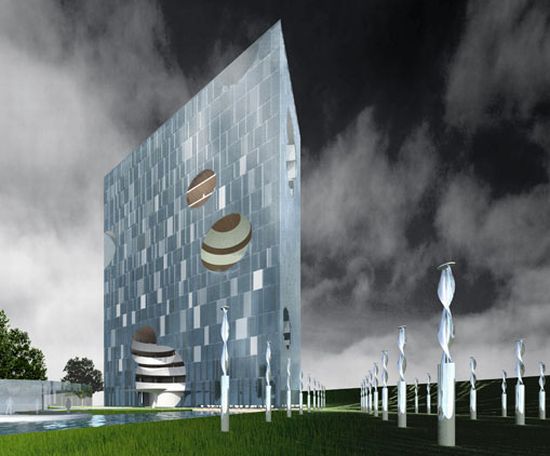
The Aviapolis Tower has been designed by K2S Architects, and will be an office building that will include and use wind generators and solar panels to generate electricity. Regarding its aesthetic, the tower will be a landmark of its own kind.
This is another great project where the architects tried to create a true sustainable and self-sufficient skyscraper, in order to bring the energy consumption to a level as low as it can. This 70 meters “Aviapolis Tower” is a prize-winning design with a slender shape and spherical voids, that will serve as common spaces, meeting areas and green spaces. This way the building will accommodate several concepts for both working and communication.
In order to fulfill the required energy demand, an energy park has been created, and will feature wind generators and solar panels built in a series. This park will be located between the building and the highway.
7.Gyre
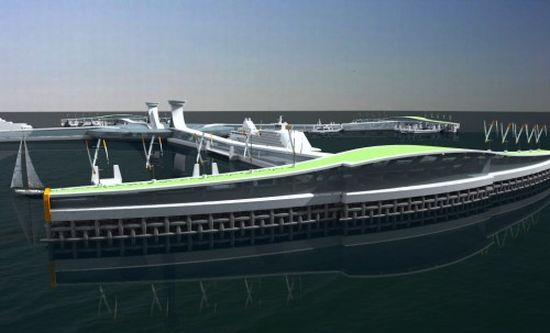
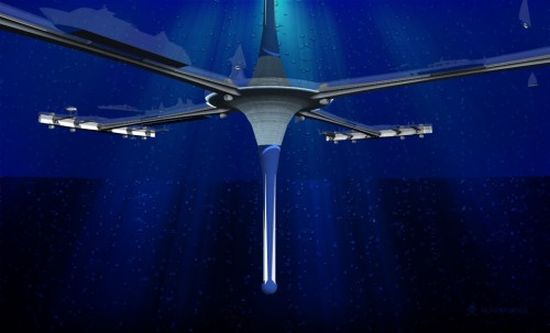
The Gyre water-scraper has been designed by Zigloo, and the concept idea is a floating development as an underwater skyscraper. The aim of this development is to bring scientists and vacationers together in order to understand the ocean, without polluting its delicate ecosystem. Being located at a depth of 400m, this water-scraper will provide enough space for a comfortable living and working environment, and will include shops, restaurants, gardens and recreation space.
The structure of this tower is actually a layering of concentric rings that range in size from 30,000 square meters down to 600 square meters. It will feature a double-hulled vortex that is covered in reinforced glass, and the total floor area will have about 212,000 square meters. The entire tower will be powered entirely by renewable energy, due to its unique design that will allow the integration of systems to harvest renewable energy from wind, the sun and tides. The renewable energy will also be generated by solar energy from windows with a glass printed array of solar cells.
Also, the underwater nacelles function as tidal generators when the structure is anchored and also as thrusters for propulsion. The mechanical systems and emergency freshwater storage basins are located in the deepest portion of the structure.
8. Burj Al-Taqa Energy Tower
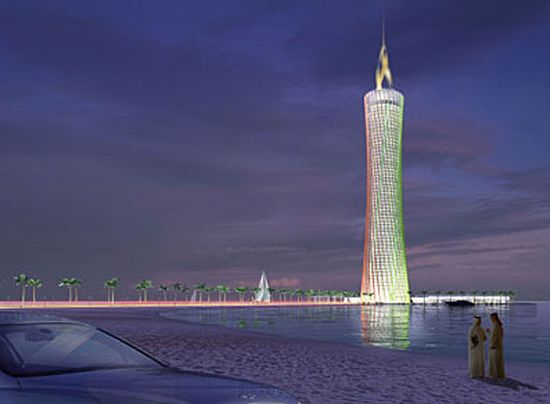
The Burj Al-Taqa skyscraper has been designed by German architect Eckhard Gerber and is a bold concept proposed for development in the Middle East. This innovative building will produce zero emissions and will use the sun, wind and water in order to produce its own energy.
The building will have an 68-story structure and a simple yet clever cylindrical design that uses natural air conditioning based on Iranian wind towers, on the principal that draws wind in and down to cool interiors. The ventilation idea is to cool the incoming air by using seawater, and then to be ventilated throughout the building using a double-skin glass façade. A central atrium is also available and will provide fresh air inflow. And that?s not all! In order to offer a better and improved radiant comfort, there are tubing throughout the ceilings that will run cool water.
Another great and important amount of energy will be provided by the sun, using a rotating solar shield that covers one sixth of the building circumference. This solar shield will provide shade at the highest incidences and it will also use an integrated photovoltaic array to capture the sun’s energy for electricity. And like this couldn’t be enough, there’s also a wind turbine on top. All of these energy solutions will cover the energy needs, and much more, the excess electricity will be applied to generate more energy by extracting hydrogen from seawater for fuel cells.
If this project will be approved it will require 60 percent less energy than the usual buildings, and will not produce CO2 emissions and. The Burj Al-Taqa skyscraper will boast a complete independence from non-renewable energy.

9.Food City
This amazing project has been designed by GCLA Architects and represents an off-the-grid sustainable complex plan for Dubai.
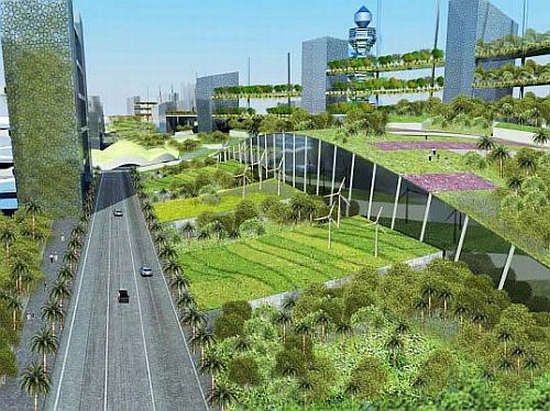
Dubai seems to be the city where every bold project and the craziest architectural dreams can be brought to life. The aim of this new Food City project is to encourage people to live the greenest possible life. Of course the architecture will be nothing like other buildings, being based on the concept of eco architecture. The architects are using a very modern approach and are pushing the limits, by incorporating green walls, aquatic farms, artificial roof landscapes and renewable energy generation at a scale no one has ever tried before.
The energy needs will be provided by concentrated solar collectors, towers draped in photovoltaic modules and piezoelectric pads in all pedestrian areas. The metropolis will use atmospheric water harvesting systems and solar energy in order to run desalination systems. The complex will also extract methane from sewage tanks for days when the sun isn’t shining.

10.Seawater Vertical Farm
The Seawater Vertical farm has been designed by Italian architects Studiomobile and like some other projects we’ve presented to you, this bold building will be also located in Dubai.
We know that Dubai it’s rich in oil, but speaking about the water the problem is quite huge and very important. It seems to be quite funny, but possessing a car in Dubai is cheaper than being the owner of a garden. That’s why, the innovative concept idea of this vertical farm is about using sea water for plantations. The technology is all about converting sea water to cool and humidify greenhouses and convert the humidity back to freshwater to irrigate the crops.
To provide the appropriate conditions for the plant growth, the air is cooled and humidified with seawater. When the air leaves the growing area it is mixed with the warm dry air, the resulting air being more humid and more hot. This new warm and humid air is then condensed, also with the use of seawater, until the condensed drops water will appear. When the water drops are starting to appear, they are collected in a tank and used to irrigate the crops.
11. Valdrade Skyscraper
The Valdrade building has been designed to bring a new concept for a city dense space, an idea based on 3 interdependent vectors: density, sustainability and diversity.
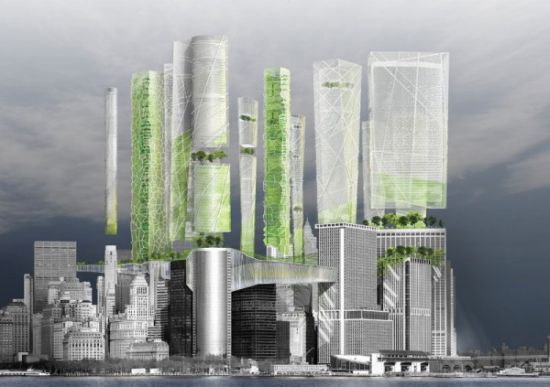
The city is considered as a true ecosystem where the self-sufficiency and self-generation are the main factors of the building. In order to enable a zero ground occupation and also to reduce the deficiencies, the Valdrade building expands as an “upper city” above the existing “lower city”. Using plug-in of self-sufficiency generators, the “upper city” provides enough energy to compensate the current buildings over-consumption.
The idea is also to provide some innovative way of recycling so that the whole cycle can slide back, so that every wasted material become some other’s raw materials and sources of energy. These self-sufficiency generators features a photovoltaic skin and wind turbines in order to provide the electricity production, lagooning for the waste water purification and recycling area for the organic and paper waste recycling and production of recycled paper, compost and gas by methanization.
The diversity is brought by the “housing reflect” of the towers so that, while the lower city parasites the ecosystem, the upper city provides energy to it by drawing a green vegetable and permeable layer between the two cities. This connection between the two cities generates a new public space at the bottom of the towers and re-establishes proximity at the level of the upper city.
These new towers offers a new attraction that stimulates connections, exchanges and synergy between the two cities. The facades of these new towers are double skins facets inspired from the environment, so that each facade is inspired from a natural element.
12.Rotating Wind Power Tower
The Rotating Wind Power Tower has been designed by David Fisher architect and is another impressive concept for Dubai. It seems like Dubai is the city where most of the future ecological buildings will be build, the city of architectural wonders.
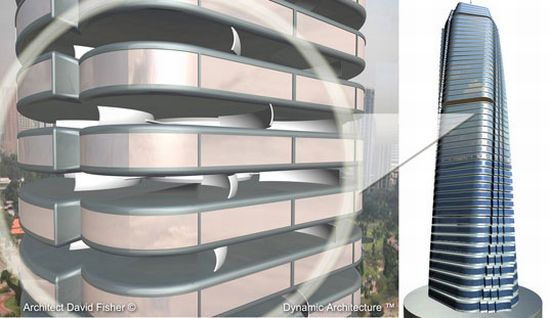
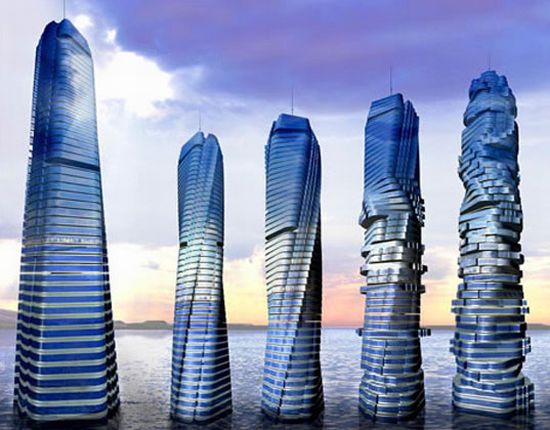
Its architecture is very dynamic due to its rotating floors that would be able to rotate around a central axis. It seems quite impossible but the architects are very confident about this project since t will offer the possibility to choose a new view at the touch of a button, so the form of the building would constantly change as each floor rotates separately giving a new view of the building as it turns. Fisher says that there’s no danger about these rotating floors, more than that, it has a very high resistance to earthquakes as each floor rotates independently.
Each floor of this new skyscraper is made up of 12 individual units, complete with plumbing, electric connections, air conditioning and it will be produced in a factory. After they are produced, each modular unit will be fitted on the concrete core or spine of the building at the central tower. Since it’s an eco friendly building, like all of the above buildings, it will use sun and wind energy. Much more, the architect claims that the building will generate 10 times more energy than required to power it.
This great amount of energy will be obtained thanks to solar panels that will be fitted on the floor, and due to 48 wind turbines will be sandwiched between the rotating floors, placed so that they are practically invisible. Each of these wind turbines will produce up to 0.3 megawatt of electricity.
13.Dragonfly
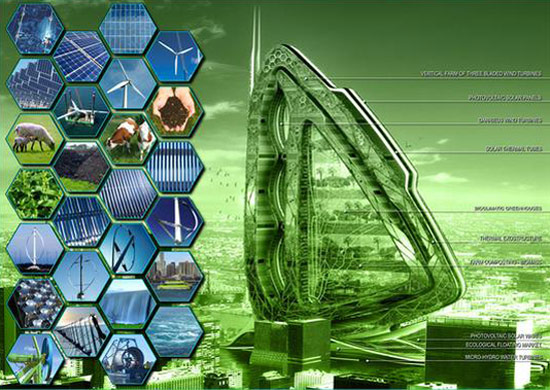
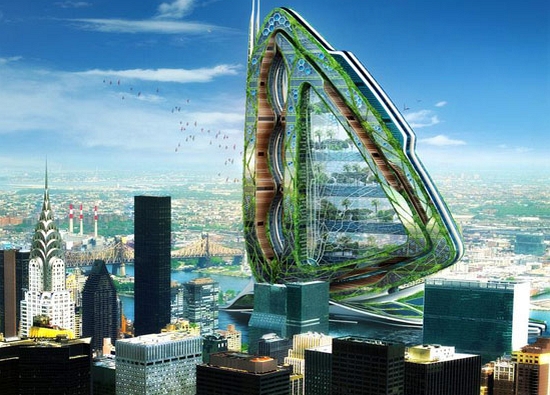
This impressive building dubbed Dragonfly has been designed by Vincent Callebaut architects and will be developed in New York. The idea of this 600m structure takes its inspiration from a dragonfly’s wing, and its vertical farm is designed to host 132 floors and can accommodate 28 different agricultural fields for the production of fruit, vegetables and dairy items.
This amazing building will also offer enough space for offices, research labs, housing and communal areas, which are spaced between orchards, farms and production rooms. The design of the structure is kept off-the-grid using wind turbines and solar panels which generates the necessary amount of energy. The energy is provided during both the winter and summer season. During the winter the space between the set of steel and glass wings takes advantage of solar energy by accumulating warm air during the cold winter season, while during the summer the plants and other vegetation provides the necessary cooling.
Since it’s a 100% self-sufficient ecosystem it will take use of the rainwater using the exterior vertical gardens, which is then mixed with domestic liquid waste and treated in order to be reused in the farms.
14.Suspended City
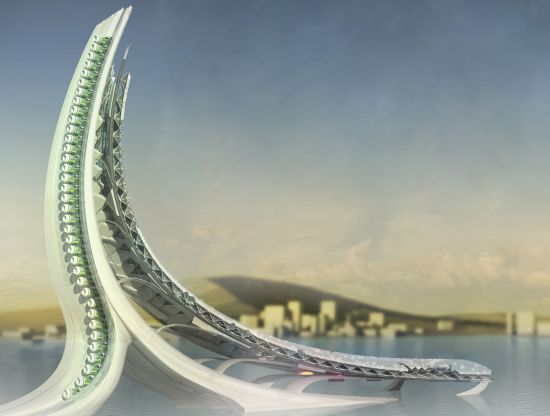
The Suspended City has been designed by Coolie Calihan and Charles Johnson and is dubbed as the Cidade Suspensa, which means Suspended City in Brazilian Portuguese, and will be located on the dense urban waterfront of Rio de Janeiro.
The idea is to create a building that could refine urban architecture and bring it in harmony with nature and the environment. The structure uses a suspension system to lift an intricate and dense city-like infrastructure off the Earth’s surface. Two pylons anchored on the ground support a web of tendons and framework that reaches into the ocean. This unique levitation system minimizes the footprint of the structure on the ground and expands opportunities for Rio’s future developments.
The structural pylons support all of the mechanical and transportation systems as well as the “biomass generator.” These generators also take advantage of hydroponics, water recycling, waste composting, fish farming and other agricultural sciences. They create a sustainable food source that can be directly distributed to the city inhabitants, thereby saving energy and reducing transportation.

15. Eco-Cybernetic City
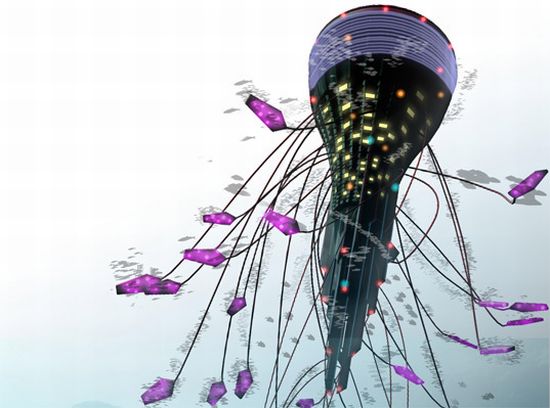
The Eco-Cybernetic City has been designed by Orlando De Urrutia and the concept idea is based on nature, resembling a forest of trees that are in search of light.
This eco building, beside the fact that is self-sufficient speaking about energy, it also features a few systems that allow it to save energy and rely on natural sources for everything from energy to water, so that the building can harvest rainwater. It also features aerogenerators that takes advantage of the airflows between the towers to generate wind energy.
The Eco-Cybernetic City features a façade of photovoltaic lattices, which generate solar energy for the building and its unique multimedia LED façade interacts with the changes in the atmosphere. The building is considered as an “alive machine” by the designers, as the building interacts with its surrounding environment. The architects will use bio-climatic panels that are easy to clean and also allows the growth of vegetation, so that the surface will create a green mantle that purifies the air surrounding it.